So here it is. The whole first layer of how a professional desk reads a market — written from absolute zero, on this page, right now. Not a preview of something. The actual thing.
Read it in twenty minutes · No signup · Nothing asked of you
First, the part nobody says to you
If you have lost money at this, it was not because you are stupid and it was not because you did not try hard enough. You were taught a version of trading that was designed to be easy to sell, by people who have mostly never traded serious money. It does not work. It was never built to work. It was built to be bought.
Here is the gap nobody shows you. A bank will pay you around eight percent a year on your money in a good year. That is considered good. This desk documented, in five months and in public, what a bank pays in about thirty years — every single trade posted before it was taken, every loss printed beside every win. The exact number is further down this page, and every one of the ninety-nine trades is on the public record inside.
That gap is not luck and it is not a secret club. It is a skill. It is learnable, and it does not care where you were born, what you earn right now, how old you are, or what you did before.
Yanis knows that because he started with nothing here either. Professional footballer from sixteen, across six countries — until a failed medical and five surgeries ended it. Before that he had spent a year in a trading course that taught him nothing that worked. Everything he knows now came after, from inside a bank: feeding the market desk as an analyst, then trading the bank's own money. He built this because the version he was sold cost him a year and never made him profitable — and because he is tired of watching it do far worse than that to people who trusted it.
Now the honest part, because you deserve it before you spend twenty minutes here. This is not easy and it is not fast. It is deep, some of it is genuinely hard, and anyone promising you otherwise is selling you something. It will take months before it feels natural.
But on the other side of that work is the only thing that ever actually changes anything: you read the market yourself. You take your own trades. You need nobody — not a group, not a signal, not even him. That is a skill nobody can take off you, in any country, for the rest of your life.
Why this page exists
Nobody is going to hand you a life. But some skills genuinely change what is possible — and this is one of the few that has no ceiling on it.
Everything below is free, and it is the real first layer. Not a preview of it. Start.
Why most of what you have seen was built to sell you something
If you have spent any time looking into trading, you have been shown the same thing over and over: a chart, some lines drawn on it, a pattern with a name, an indicator that turns from red to green. Learn the patterns, the story goes, and the money follows.
It does not follow. And the reason is simple once somebody says it out loud: a chart is a picture of what already happened. It is a record of decisions other people already made. It tells you nothing about why they made them, and nothing about what they are about to do next.
Almost nobody teaching trading online has ever traded institutional money. What they have is an audience. The pattern-and-indicator version of trading is not taught because it works — it is taught because it is easy to package and easy to sell. You can film it in a weekend. Real market reasoning takes years and does not fit in a carousel.
This page is the other version. It is what people who move real money actually look at, in the order they look at it.
02
Who actually moves price
It is not you, and it is not anyone in your group chat
Currency markets trade trillions of dollars a day. That volume is not retail traders. It is central banks, commercial banks, pension funds, sovereign wealth funds, companies that sell abroad locking in their prices, insurers, and a handful of macro funds.
None of them wake up and buy because a candlestick closed a certain way. They move money because something changed in the world that makes one currency worth more, or less, than it was yesterday. An interest-rate expectation shifted. An inflation print surprised. Oil moved and their country imports all of it.
Understand what that means. When price moves hard, it is because a large institution changed its mind about the future — and the chart is just the receipt. If all you have is the receipt, you are permanently one step behind the decision.
The line to keep
Price is the shadow. The macro is the thing casting it.
03
The five forces
Everything that moves a market fits in one hand
This is the part nobody assembles for you. Every move in every market traces back to five things:
One — interest rates, and more precisely where the market expects them to go. Money flows toward where it gets paid more to sit.
Two — inflation, because inflation is what forces a central bank's hand on rates.
Three — growth, because a slowing economy eventually gets rate cuts and a booming one gets hikes.
Four — risk appetite: whether the world currently wants to own risky things or safe things.
Five — positioning and flows: what everyone is already holding. A market where everyone is on one side moves violently when a few of them leave.
That is the whole board. Not fifty indicators. Five forces, and the endless question of which one is in charge this month.
04
Central banks: the most powerful player on earth
One meeting, every chart you watch
A central bank sets the price of money for an entire economy. When it moves, everything priced in that money reprices — the currency, the bonds, the stock index, the property market, your mortgage.
Here is the part that separates people who understand this from people who repeat it: the decision itself is usually not the trade. By the time a central bank raises rates, the market has been pricing that rise for weeks. The move already happened.
What moves price is the gap between what was expected and what was delivered — and the language used about what comes next. A bank can raise rates and the currency can fall, because the statement sounded like that was the last one. This happens constantly, and it destroys anyone trading the headline instead of the expectation.
The line to keep
You are never trading the news. You are trading the distance between the news and what was already priced.
05
The market has weather
Risk-on, risk-off — and why it explains half of what confuses you
Some days the world wants to own things that pay well if the future is good: stocks, high-yielding currencies, the Australian dollar. Other days it wants shelter: the dollar, the Swiss franc, the yen, government bonds.
That is the weather. And it explains something that drives new traders mad — why a currency can fall on genuinely good news. The news was fine. The weather turned, and the whole risk side of the market went down together, your pair with it.
Once you can see the weather, an enormous amount of apparently random price action stops being random. You stop asking "why did my pair drop" and start asking "did everything like my pair drop, and if so, what scared the world this morning."
06
The mistake that costs more than any bad entry
Every correlation is conditional. This is the chapter that matters most.
Now the real thing. Everything above is the vocabulary — this is the grammar, and it is where nearly all macro teaching stops and gets people hurt.
You will be taught rules that sound like laws. "Gold is a safe haven — when there is fear, gold goes up." It is repeated everywhere. And it will lose you money, because it is not a law. It is a behaviour that only shows up in certain conditions.
The naive rule
Fear rises, so gold rises. Buy gold when the world looks frightening.
The actual mechanism
Gold pays you nothing to hold it. So its real competition is the return you could get risk-free instead — the yield on government bonds after inflation. When that real return climbs, holding gold gets expensive and gold falls, no matter how frightening the news is. When it falls, gold gets cheap to hold and rises.
So the question is never "is this risk-off"
It is what kind of shock is this, and what does it do to real yields. Watch it in a real market — this happened in 2026, and the desk traded through it. When the war started, everyone who had memorised the rule bought gold. What actually happened: the war created inflation risk, central banks turned hawkish, and it was the dollar that became the safe haven — gold dropped while every headline on earth screamed fear. Then the regime at the Fed changed. The forward guidance disappeared — nobody knew any more whether the next move was hawkish or dovish — and that uncertainty, not the war, is what sent gold back up, even as the war itself cooled. Same asset, same "safe haven" label, opposite behaviour twice. The environment decided.
This is the difference between knowing macro words and being able to use them. And it generalises: the dollar is not always the safe haven, oil is not always inflationary, a rate hike does not always lift a currency. The environment decides what leads. Your job is never to memorise the rule — it is to work out which force is in charge right now, and what that means for what you are looking at.
The line to keep
There are no permanent correlations. There is only what is leading right now — and the work is finding out.
07
Charts — the retail version and the desk version
Technical analysis is not the enemy. Being told it is the whole game is.
Nothing above means charts are useless. A desk uses them every single day.
The difference is where they sit. Retail trading starts at the chart and hopes to reverse-engineer a reason. A desk arrives at the chart already knowing what it thinks and why — the macro said which currency should be strong and which should be weak — and uses the chart to answer a much narrower question: where do I get in, where am I wrong, and how much do I risk.
Same tool. Completely different job. The chart is the last layer, not the first, and it is the layer that answers where and never why.
08
How to read a track record without being lied to
If you cannot measure it honestly, someone is lying to you — probably on purpose
You are going to be shown a lot of results. Here is how to tell what is real, and it is the most immediately useful thing on this page.
Was it posted before the trade, or after? A screenshot of a winner proves nothing — anyone can post the ones that worked and quietly delete the rest. The only claim worth anything is one made before the outcome was known, in public, where it cannot be edited.
Are the losses there? A record with no losses is not a good record. It is an incomplete one. Everybody loses. A record that hides it is telling you exactly what kind of person is keeping it.
Is risk stated? "Up 40%" means nothing without knowing what was risked to get it. Doubling an account by betting a quarter of it per trade is not skill, it is a coin flip that landed.
Are the breakevens counted? Most people quietly drop them, because a trade that made nothing drags the win rate down. Leaving them out flatters the number.
Now use it on this desk. Everything below is public, dated, and was posted before entry or called live with members watching it happen. A trade with no advance notice does not go on the record — winners included.
The Desk · Five Months · Documented
+244.67%
Apr–Aug 2026 · Added, Never Compounded
99
Trades · Posted Before Entry Or Called Live
56.6%
Win Rate · Breakevens Counted
1%
Risk Per Trade · Never More
April
+50.67%
May
+29.35%
June
+49.02%
July
+47.26%
August
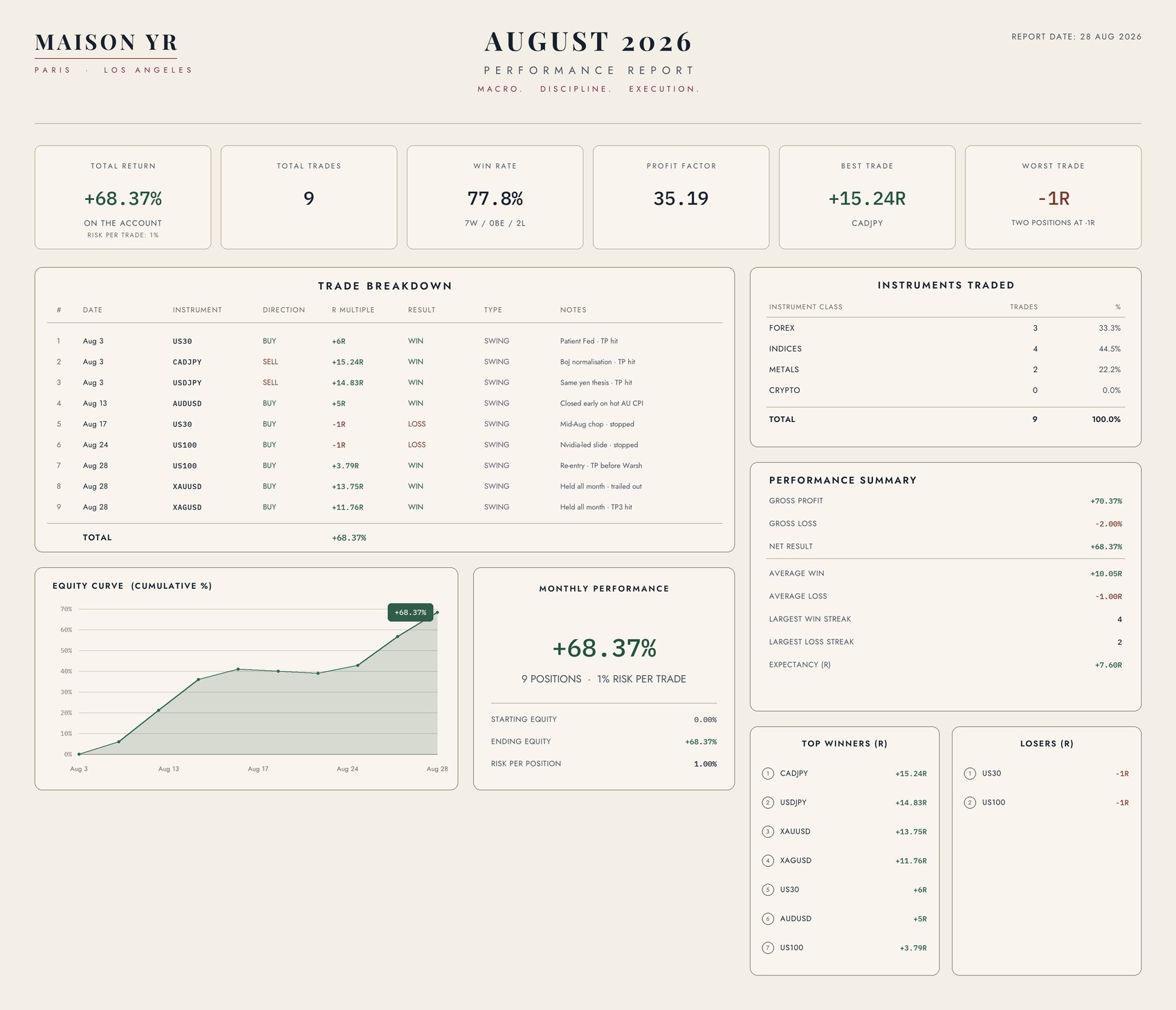
+68.37%
Ninety-nine trades: 56 wins, 20 breakevens, 23 losses. The breakevens are counted as trades and the losses are printed at full size. Six of the ninety-nine were taken at half risk and are marked as such on the cards. Months add — they are never compounded.
One month's report card · August 2026 · tap to read it in full09
One real trade — the win and the six stops
The same read that paid one of the biggest trades on the record then cost six losses
April, the Japanese yen. The read was macro, and it was not complicated: the Bank of Japan had let its currency get extremely weak, weak enough that intervening to defend it had become a real possibility, and the market was positioned heavily on one side.
That read paid +10.05% of the account across two legs on 30 April — April's largest single trade, and the largest on the public record until August took the title. One correct macro thesis, executed in two parts. One trade, a tenth of the account, because the read was right and the size was disciplined.
Here is the part nobody shows you. The same read later cost six stopped-out trades — about one percent each. The thesis had been right, the environment moved on, and continuing to trade the old idea cost money six separate times.
Both are on the record. The win and the six stops. That is not humility for the sake of it — it is the actual lesson: being right is not permanent. The environment that made a thesis work is the same environment that eventually kills it, and knowing when your own idea has expired is most of the job.
The line to keep
A thesis has a shelf life. The market will not tell you when it expired — your risk rules will.
10
Why 1% decides everything
The least exciting rule in trading is the one that chooses who is still here next year
Risk one percent of your account per trade. That is it. That is the rule.
It sounds so boring that almost everyone ignores it, and ignoring it is the single most common reason accounts die. Not bad analysis. Size.
Run the arithmetic. At one percent, ten losses in a row — a genuinely terrible run — leaves you down about ten percent. Uncomfortable, survivable, and you are still trading. At ten percent per trade, that same run is most of your account gone, and now you are trying to win it back, which is when people stop thinking and start gambling.
The professional edge is not being right more often. On this record the win rate is 56.6% — barely better than a coin. The edge is that the wins are bigger than the losses and the risk is capped — one percent or less, never more. That is the entire mechanism. It is arithmetic, not talent.
The line to keep
You do not need to be right often. You need to survive being wrong.
The road
What the path actually looks like
So you know what you are walking into
Now
You understand what moves price. That is this page. Most people trading today cannot do what you just did.
Next
The free room. The Macro Starter Pack — ten more chapters from zero, on the page or as a PDF — plus two complete chapters of the Macro School, the wall of receipts, all five report cards, and a free seat in the live Market Room every other Sunday.
Then
You watch it done live. The desk runs Tuesday to Friday as markets merit — minimum two live sessions every week, guaranteed in writing — every position posted before entry with the full reasoning. A desk morning has one shape: before the data, a briefing — what the desk expects and what would change its mind. The number prints. Then the recap — what actually happened, what the desk did about it, and the result in percent, win or loss. You stop reading about macro and start watching it turn into decisions.
Then
You take your own. The twenty-one chapters, the twelve rules of the house, the risk gate every member passes before they are allowed to size up, and a desk that answers when you get it wrong.
After
You trade capital that is not yours. The route to a funded account, mapped, and built to run around a full-time job.
The point
You need nobody. Not a group, not a signal service, not this one. That is the entire objective and it is the only honest one.
It is months, not weeks. But every step of it is real, and the first two cost nothing.
Why this exists
What this skill is actually worth
A bank will pay you around eight percent a year on your money in a good year. That is considered a solid return. Thirty years of that is roughly what this desk documented in five months.
That is not a boast — the record is above and you can audit it. It is a statement about what the skill is worth once you have it. There is no ceiling on it, and it does not care where you started, how much you have, or what your job is. It is a way of reading the world that pays you for understanding it correctly.
Yanis played professional football from sixteen, across six countries. In 2023 he failed a medical at a Premier League club, had five surgeries, and it ended. What he had left was the thing he had been building underneath it: a year in a trading course that taught him nothing, then a bank — feeding the market desk as an analyst, then trading the bank's own capital.
He built this because the education that exists is mostly built to be sold, not to work. The objective is not to keep you following him. It is that you understand the market well enough to need nobody — not him either.
The honest part
You will never feel ready. There is no month where the free reading finally makes you prepared. At some point you just start.
And that is the thing worth saying plainly, because it is true and almost nobody says it: you can consume free material forever and it will not make you a trader. It will make you someone who knows about trading. Those are different people with different bank balances. What you have just read is real and it is the correct first layer — but it is the first layer.
Where to go from here
There is a lot more of this, free, and it does not cost you anything but the click. The Lobby has the Macro Starter Pack — ten more written chapters from zero, yours on the page or as a PDF — two complete chapters of the Macro School exactly as members read them, the wall of receipts with every loss printed beside every win, all five monthly report cards, and a free seat in the live Market Room every other Sunday — the same room the members sit in, questions until they run out.
That is the free side, and it is genuinely free. No card, no call.
And when you want the rest — the desk running Tuesday to Friday as markets merit with a minimum of two live sessions every week guaranteed in writing, every trade posted before entry with the reasoning, the twenty-one chapters of the Macro School, the whole road to trading funded capital — the door to the Live Trading Floor is inside, and the price and the details are on the website. Read the free room first. Decide in your own time.
MAISON YR is an online education house — curriculum, community and live sessions. Nothing on this page is financial advice or a recommendation to buy or sell anything. Performance is shown in percentage and R; past performance is not indicative of future results.